
How Factories Simulate Long-Term Use to Validate Product Durability
When you pick up a stainless steel water bottle or shaker bottle, you expect it to survive daily bumps, drops, repeated washing, and thousands of opens and closes. Behind the scenes, manufacturers like Wuyi Hongtai Stainless Steel Drinkware Co., Ltd. put products through rigorous simulated long-term use tests to ensure they meet durability standards before reaching wholesale buyers and consumers.
Why Simulation Matters for Stainless Steel Drinkware
Stainless steel drinkware is designed for years of service. But how can a factory prove a bottle will still perform after months of heavy use? The answer lies in accelerated life testing, where machines replicate real-world wear and tear in a compressed time frame. For a professional supplier like Hongtai, this validation is critical to maintaining trust in their water bottles, vacuum flasks, tumblers, and shaker bottles.
Key Simulation Methods Used in Factories
Factories typically combine mechanical, thermal, and chemical tests to simulate long-term usage. Here are the most common approaches used in stainless steel drinkware production:
1. Repeated Drop and Impact Testing
To simulate accidental drops, factories use drop testing machines that release bottles from specified heights onto hard surfaces. The test is repeated hundreds or thousands of times, at different angles and temperatures. This validates the integrity of the stainless steel body, the welding seams, and the powder coating or paint finish. A durable bottle should not dent easily or lose its protective layer.
2. Cycle Testing for Lids and Seals
Lids, caps, and silicone seals are often the first parts to fail. Factories use automated cycling machines that open and close the lid or cap thousands of times — sometimes up to 10,000 cycles or more — to simulate years of daily use. This test checks hinge strength, thread wear, seal compression, and leak-proof performance. For tumblers with sliding lids or shaker bottles with flip caps, this is essential.
3. Thermal Cycling and Vacuum Integrity Tests
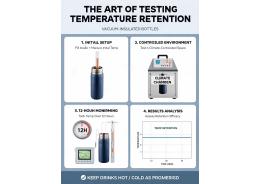
Vacuum flasks and insulated bottles rely on a double-wall vacuum layer. Temperature changes can stress the metal and cause vacuum loss. Factories simulate long-term thermal exposure by cycling bottles between boiling water and ice-cold water repeatedly. They also use vacuum gauges to measure whether the insulation performance degrades over time. This ensures that products like Hongtai's vacuum flasks retain heat or cold for many years.
4. Pressure and Leak Tests
Beverage containers must withstand internal pressure from carbonated drinks or hot liquids. Factories use air pressure testing rigs to pressurize bottles beyond normal usage levels, then check for deformation or leaks. Additionally, leak tests are performed by filling bottles with water, sealing them, and rotating or shaking them in a test fixture to simulate transport and handling. This long-cycle leak detection helps prevent failures in real life.
5. Abrasion and Scratch Testing
The exterior of a stainless steel bottle goes through constant friction against bags, cup holders, and tables. To simulate years of abrasion, factories use a Taber abraser or equivalent equipment that rubs the surface with abrasive wheels under controlled pressure for many cycles. This verifies the scratch resistance of the powder coating, paint, or brushed finish.
6. Chemical and Corrosion Resistance Testing
Drinkware is exposed to acidic beverages, detergents, and hard water. Factories simulate long-term chemical exposure by soaking bottle samples in acidic or alkaline solutions at elevated temperatures for extended periods. Salt spray tests (e.g., ASTM B117) are also used to evaluate corrosion resistance of the stainless steel and coatings. This ensures that products like Hongtai's A-Alcohol Series or outdoor bottles do not rust or stain after months of use.
Data Collection and Continuous Improvement
Simulation is not just about passing or failing. Advanced factories record data from sensors, cameras, and torque meters during tests. They analyze failure modes and feed results back into the design process. For example, if a cap cracks at 5,000 cycles, engineers may adjust the material formulation or rib design. This is how manufacturers like Hongtai improve their water bottle and tumbler lines to offer better long-term value to wholesale clients.
Standards and Certifications
Most factories follow internationally recognized standards for durability testing, such as ASTM, ISO, or BIFMA. These standards define test parameters like drop height, number of cycles, and acceptable performance limits. A professional supplier will be happy to share their testing protocols and certificates with buyers. Always ask your stainless steel drinkware manufacturer about their accelerated aging tests and quality control reports.
Conclusion
Simulating long-term usage is the only way a factory can be confident that a stainless steel bottle will survive real life. From drop testing to thermal cycling to abrasion and chemical resistance, each method targets a different mode of wear. When you choose a supplier like Wuyi Hongtai Stainless Steel Drinkware Co., Ltd., you benefit from their experience in manufacturing and exporting water bottles, shaker bottles, and more — all validated through simulated durability tests. Always prioritize a manufacturer that invests in this kind of quality assurance, because durability is not a promise — it must be proven.
Contact Hongtai for wholesale inquiries or to request their testing documentation: [email protected] | +86 15058650652 | Baihuashan Industrial Zone, Baiyang Street, Wuyi, Jinhua City, Zhejiang Province, China, 321200
 English
 German
 French
 Russian
 Spanish
 Japanese
 Korean
 Portuguese
 Ukrainian
 Arabic
 Italian

